
Here’s a question most homeowners can’t answer confidently: when did you last change your air filter? Not when you think you should have — when you actually did it. For most people, the honest answer is either “a while ago” or “I’m not sure.”
That one overlooked task affects your indoor air quality, your energy bill, your HVAC system’s lifespan, and on a bad day, whether your AC is blowing cold air at all. Ignoring routine filter maintenance can strain fan motors and shorten the life of your entire HVAC system. Smart maintenance today prevents costly repairs tomorrow.
This guide gives you a straight answer on how often to change your air filter based on your actual situation — not a generic rule that ignores whether you have dogs, allergies, or a vacation home. It also explains which filter to buy, because the wall of options at the hardware store is genuinely confusing and most people grab the wrong one.
Why Your Air Filter Matters More Than You Think
The air filter in your HVAC system does two separate jobs that most homeowners don’t realize are both happening at once.
First, it protects the mechanical components of your system. Every particle that gets pulled into the return air — dust, pet hair, skin cells, lint — would otherwise coat the blower motor, evaporator coil, and heat exchanger if nothing caught it. Air filters are typically made from spun fiberglass or pleated paper and cardboard, and they’re inserted into a specific place within your return air duct. They trap airborne contaminants to prevent them from being recirculated throughout your house.
Second, it affects the air your family breathes. A filter that’s doing its job keeps dust, pollen, pet dander, and mold spores out of the air that cycles through every room in the house.
Here’s the part people don’t expect: when a filter gets too dirty, it stops doing either job well. An old, clogged filter doesn’t work as well, but it can also strain your HVAC system — leading to higher energy bills and potential damage over time. And a severely clogged filter restricts airflow enough to freeze the evaporator coil, which is exactly the kind of thing that makes your AC stop cooling the house on the hottest day of summer.
The filter is a $10 to $30 part that protects a $5,000 to $12,000 system. Keeping up with it is one of the highest-return maintenance habits in the whole house.
The General Rule — And Why It Doesn’t Fit Everyone
Generally, most air filter manufacturers and HVAC companies recommend changing your air filter every 90 days, or 3 months. That’s the number you’ll see on most packaging and in most general guides. It’s a reasonable baseline, but it assumes a fairly average home — a few people, no pets, moderate climate, standard filter.
The reality is that most homes don’t fit that baseline perfectly. The right answer for your home could be as frequent as every three to four weeks, or as infrequent as once a year, depending on several factors. The sections below walk through each one.
What Actually Determines How Often You Need to Change It
The Type and Thickness of Filter You Use
This is the biggest factor, and it’s one most homeowners don’t account for when they buy a replacement.
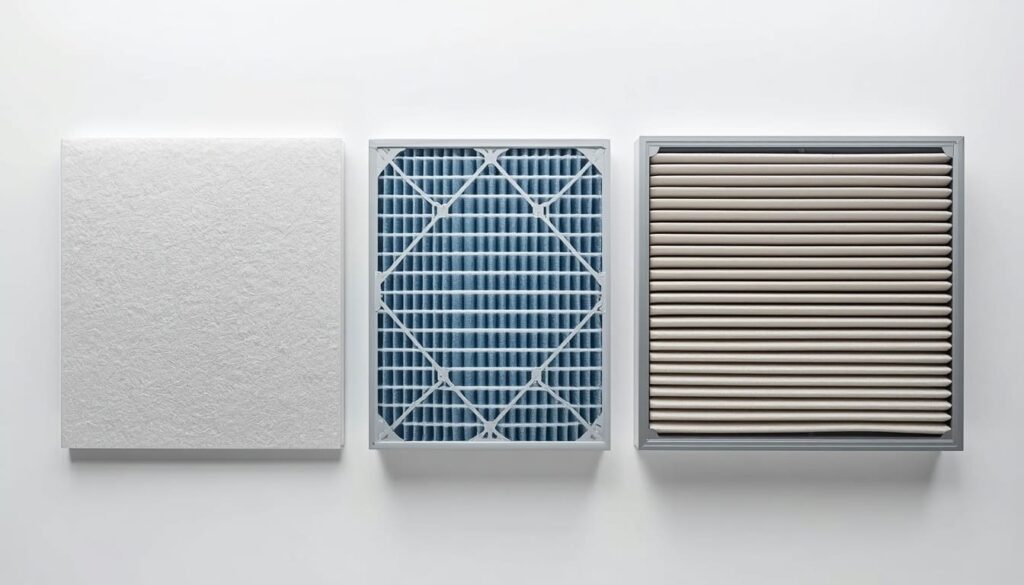
Fiberglass air filters are the more affordable of the two main types but less efficient at capturing dust and particles. They generally need to be changed every 30 days or less. Pleated air filters are more expensive at the outset but also more efficient at trapping particles and can last up to 90 days, depending on use.
Thickness matters just as much as material. As a general rule, a 1-inch filter should be changed about once a month, while a 4-inch filter typically lasts around six months. Some high-capacity filters are designed to last a full year.
If you’re currently buying the cheap fiberglass filters and replacing them every month, switching to a 4-inch pleated filter can cut that to two or three times a year — and give you better filtration in the process. Whether your system can accommodate a thicker filter depends on the filter slot in your air handler; check the space before buying.
Whether You Have Pets
Pet hair and dander load up a filter faster than almost anything else in a typical home. Homes with pets may need filter changes every 60 days to handle extra dander.
If you have one dog or one cat, plan on changing your filter every 60 days as a baseline. Two or more pets, or a breed that sheds heavily — think golden retrievers, huskies, or long-haired cats — often means getting closer to every 30 to 45 days during shedding seasons.
The visual check matters here. If you pull the filter out at 60 days and it’s already dark gray and visibly packed, don’t wait for the calendar. Change it now and note how long it actually took to reach that point, then use that as your actual schedule going forward.
Allergies and Respiratory Conditions in the Household
A dirty air filter can affect people with allergies or respiratory conditions like asthma and COPD, as their lungs are more sensitive to dust and debris. This can sometimes lead to severe health issues, including asthma attacks. If you have any of these conditions, it’s recommended to change your air filters on average every 20 to 45 days.
If someone in your household manages allergies, asthma, or other respiratory issues, a shorter replacement cycle paired with a higher-rated filter makes a real difference in daily comfort. The filter change interval and the filter type are not separate decisions — they work together.
How Often the System Actually Runs
How often you use your air conditioning and furnace affects the filter’s lifespan. In the summer and winter, when your HVAC system is running constantly, you may need to replace filters more frequently. During these peak seasons, check the filter monthly and plan to change it every 30 to 60 days. On the other hand, if the system is used less frequently during mild weather, the filter may last longer — up to 90 days.
A system in Phoenix running 10 hours a day in July fills a filter much faster than the same system in a mild climate running 2 hours a day. Total runtime matters more than calendar time.
For vacation homes or properties that sit empty for long stretches, filters last much longer simply because so little air is moving through them. If you rarely use your HVAC system, such as in a vacation home, the filter may only need to be replaced once or twice a year.
Home Size and Number of Occupants
Large homes circulate larger amounts of air through the furnace or air conditioner, which means the filter may get dirtier faster and require more frequent replacement.
More people also means more of everything that ends up in a filter — dust, skin cells, cooking particles, tracked-in debris. A household with fewer occupants might get away with changing the filter every 90 days, while a busier household should consider changing it more often.
Dusty Climates, Construction, and Renovation
The location of your home affects how fast filters clog — dusty, dry climates mean the filter fills up faster.
If your home is near a construction site, a dirt road, or you’re doing any remodeling indoors, pull the filter out after two to three weeks and take a look. Drywall dust in particular moves through a house in enormous quantities and can clog a filter that would otherwise last 90 days in a matter of weeks.
A Quick Reference Schedule by Household Type
This is the cheat sheet for most situations:
Vacation home or rarely used system: Every 6 to 12 months
Single person, no pets, no allergies, 1-inch filter: Every 60 to 90 days
Average household, 1 to 2 people, no pets: Every 90 days
Small home with 1 dog or cat: Every 60 days
Family of 4, average conditions: Every 60 to 90 days
Multiple pets or heavy shedding breeds: Every 30 to 45 days
Allergy or asthma sufferers in household: Every 20 to 45 days
During active home renovation or nearby construction: Every 2 to 4 weeks
Peak summer and winter seasons, any home: Check monthly, replace sooner if visibly dirty
These are starting points, not rules. The real guide is looking at the filter itself when you pull it out. If it’s light gray and you can still see the filter material through the dust, it has life left. If it’s dark gray or brown and the surface looks packed, change it now regardless of how long it’s been in.
Which Filter to Buy — MERV Ratings Explained Simply
Walk into any home improvement store and you’ll find a wall of filters with prices ranging from $2 to $40 and labels like MERV 8, MERV 13, FPR 10, and MPR 2200. Here’s what it all actually means.
MERV stands for Minimum Efficiency Reporting Value. It’s a standardized scale developed by ASHRAE — the American Society of Heating, Refrigerating and Air-Conditioning Engineers — that measures how effectively an air filter captures airborne particles of different sizes. The scale runs from 1 to 16 for standard HVAC applications. A higher number means the filter catches smaller particles at a higher rate.
The ASHRAE rating system is the standard for comparing filters across different brands. The ASHRAE standards for HVAC filter performance define the testing methodology behind MERV ratings, which is why MERV is the only number worth paying attention to — other ratings like FPR and MPR are proprietary systems created by retailers and don’t translate across brands.
Here’s how MERV ratings break down for residential use:
MERV 1 to 4: Fiberglass flat-panel filters. These catch large particles like dust bunnies and debris that would damage the blower motor but do almost nothing for allergens, pet dander, or fine particles. They’re cheap ($2 to $4) but genuinely not worth using in a home that anyone lives in.
MERV 5 to 7: Basic pleated filters. Better than fiberglass, catch pollen and some mold spores. Adequate for a vacation property or a garage shop.
MERV 8: For the average homeowner, a MERV 8 pleated filter is the industry recommendation. It provides enough filtration to protect your HVAC equipment from dust buildup while catching common household allergens like pollen and dust mites. This is a solid choice for a home with no pets and no respiratory conditions.
MERV 11: The step up that covers pet dander, mold spores, and finer particulates. MERV 11 provides superior protection against pet dander and mold spores. Good choice for homes with one or two pets or mild allergy sufferers.
MERV 13: MERV 13 is the highest rating most residential HVAC systems can support without restricting airflow, and it’s now the ASHRAE-recommended residential minimum for homes with air quality concerns. Catches smoke particles, bacteria-sized particles, and very fine dust. Recommended for allergy and asthma households.
MERV 14 and above: Generally not recommended for residential systems. If you put a high-MERV filter in a system that wasn’t designed for it, your blower motor has to work twice as hard to pull air through the dense material — leading to higher energy bills, short-cycling, a frozen evaporator coil in summer, and premature motor failure.
What about HEPA filters for your HVAC? Most residential HVAC systems cannot generate enough airflow to effectively use true HEPA filters without modifications. For 99% of homeowners, high-quality pleated MERV filters deliver the right combination of performance, system compatibility, and value. If you want HEPA-level filtration, use a portable HEPA air purifier in bedrooms or primary living areas alongside your standard MERV filter in the HVAC.
What MERV Rating Should You Actually Buy
Skip the fiberglass completely. The price difference between a MERV 4 fiberglass filter and a MERV 8 pleated filter is $3 to $6, and the performance difference is significant enough that the cheap filter isn’t saving you anything.
MERV 8 to 13 pleated filters are the sweet spot for most homes. They provide a great balance of effective particle capture and healthy airflow, protecting both your air quality and your HVAC equipment.
Here’s a simple decision:
No pets, no allergies, otherwise average household: MERV 8
One or two pets, or mild seasonal allergies: MERV 11
Multiple pets, significant allergies, or asthma in the household: MERV 13
Check your system’s manual or the filter slot label before jumping to MERV 13. Some older systems or systems with undersized blower motors struggle with the added resistance of a very dense filter. If your system is older or if you notice airflow seems weaker after switching to a higher MERV filter, drop back to MERV 11.
One note on washable filters. While washable filters seem eco-friendly, they often have lower MERV ratings and must be completely dry before being reinstalled. Putting a damp filter back in your furnace invites mold to grow inside your ductwork. They also tend to perform less consistently than disposable pleated filters at equivalent ratings.
How to Actually Check Your Filter Without Guessing
Set a recurring reminder on your phone for every 30 days — not to change it, just to check it. Pull it out, hold it up to a window or light source, and look at it.
If you can see light through it and the material still looks mostly white or light gray, it’s fine. Put it back and check again in 30 days.
If it’s clearly gray or brown, looks packed, or you can’t see light through it at all, change it now. Don’t wait for a schedule.
Change filters every 60 to 90 days, or sooner if they appear gray or dirty. Monitor system performance — if you notice reduced airflow from your vents, consider whether the filter is clogged or whether you need a lower MERV rating.
While the filter is out, look at the slot it sits in. If there’s dust buildup on the edges of the housing or visible debris on the ductwork just past the filter slot, wipe it down with a dry cloth. This buildup bypasses the filter entirely when it gets dislodged.
Where to Find Your Filter and What Size to Buy
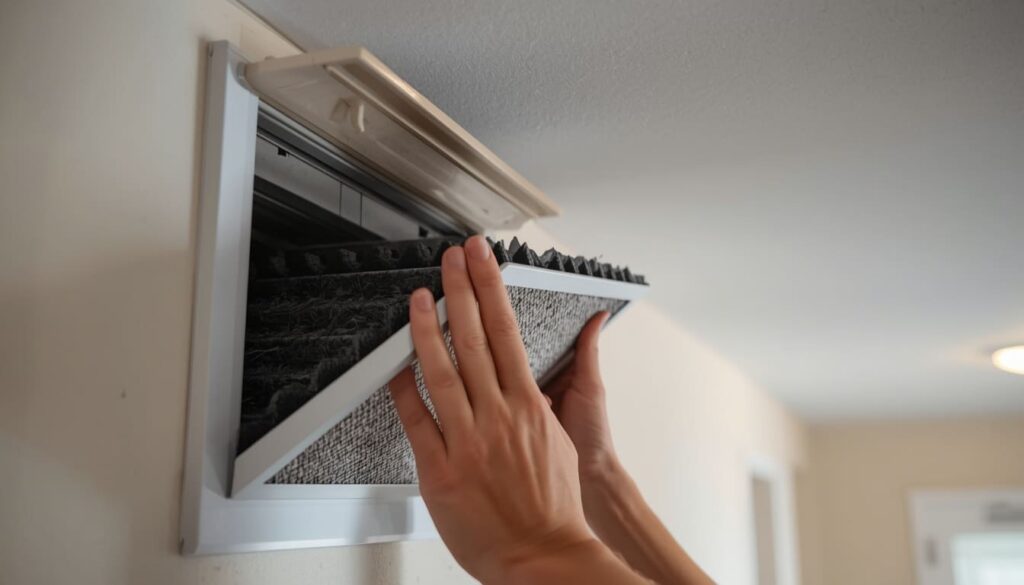
If you’ve never changed yours before, the filter is typically located in one of two places. It’s either in the return air vent — a large louvered grill on a wall or ceiling, usually in a hallway — or it’s in the air handler unit itself, usually in a utility closet, basement, or attic.
The size of the filter is printed on the cardboard frame of the existing filter. It will read something like 16x25x1 or 20x25x4 — width, height, and depth in inches. Write it down or take a photo before you go to the store.
Ensure proper fit — the filter should fit snugly without gaps around the edges. Check airflow direction — there are arrows on the filter frame indicating airflow direction, and they should point toward the blower, away from the return air.
If the filter wobbles or leaves a visible gap at any edge, it’s the wrong size. Air bypasses the filter entirely through gaps, which defeats the whole purpose.
One More Thing Worth Doing
If you find yourself changing filters frequently because they clog within a few weeks, and you haven’t changed your habits or filter type, that can be a sign your ductwork has a return air leak pulling in unconditioned air — and dust — from an attic or crawlspace. It can also mean your home has more particulate matter in the air than expected from occupants and pets alone, which is worth investigating.
Consistently short filter life combined with a system that seems to run longer than it used to is often the first visible sign of a more systemic issue. An HVAC technician can check static pressure and duct integrity in under an hour, and catching a duct problem early is significantly cheaper than dealing with a failed blower motor later.
FAQ
How do I know if my air filter needs to be changed?
Pull it out and look at it. Replace it sooner if the filter appears gray or dirty — visual inspection is the most reliable guide, more so than a fixed calendar schedule. A filter that still shows white or light gray material and allows light through when held up to a window has life left. One that’s dark, packed, or smells musty should be replaced immediately.
Can a dirty air filter damage my AC or furnace?
Yes, and it’s one of the more common causes of preventable HVAC failures. A clogged filter restricts airflow over the evaporator coil, which causes the coil to ice over. A frozen coil means the system keeps running without producing cold air, and in some cases stresses the compressor — the most expensive component in the system. On the heating side, restricted airflow over the heat exchanger causes it to overheat and cycle off on a safety limit. Both situations can eventually cause component failure if left unaddressed.
Is a higher MERV rating always better?
No. Using an air filter with a MERV rating higher than what your furnace or air conditioner manufacturer recommends can actually impair its performance. The smaller pores in more highly rated filters create resistance to airflow, and if the filter is used in a system not designed to handle this resistance, it can lower efficiency, decrease indoor air quality, and put strain on the fan motor. Match the MERV rating to your system’s capability and your household’s actual needs.
What’s the difference between MERV 8 and MERV 13 in practical terms?
MERV 8 captures 70 to 85 percent of particles in the 3 to 10 micron range — things like larger pollen and some pet dander. MERV 13 captures 50 percent or more of particles down to 0.3 microns, including fine dust, smoke, and most bacteria-sized particles. For a home with no pets and no respiratory conditions, MERV 8 is genuinely sufficient. For a home with allergy or asthma sufferers, the jump to MERV 13 makes a meaningful real-world difference in air quality.
Can I clean and reuse a disposable filter?
You can try, but it’s not worth it. Disposable pleated filters are designed to be replaced, not cleaned. Vacuuming them removes surface dust but leaves fine particles embedded in the media, and the structural integrity of the pleats degrades when wet. A used filter that’s been vacuumed provides less filtration than a fresh one. At $10 to $20 per filter, replacing it is the better choice.
My filter looks fine after 90 days. Do I still need to change it?
If it genuinely still looks light gray and airflow seems normal, you can extend the interval slightly — but 90 days is generally the maximum for a 1-inch filter regardless of appearance. Some particle types, including fine mold spores and bacteria, aren’t visible to the naked eye even when the filter has accumulated meaningful amounts of them. For thick 4-inch filters, visible inspection at 90 days often shows there’s still life left, and many can legitimately run 6 months.
Does air filter brand matter?
Less than most people think. What matters most is the MERV rating, the correct size, and a snug fit with no gaps. Name-brand filters (Honeywell, 3M Filtrete, Lennox) are made to consistent quality standards, but many store-brand or online pleated filters at the correct MERV rating perform comparably at a lower price. Avoid extremely cheap packs of fiberglass filters — the savings aren’t worth the reduced protection.
What happens if I run the HVAC with no filter at all?
Within a few weeks, dust and debris accumulate on the evaporator coil and blower components. Coil buildup reduces heat transfer efficiency and eventually requires professional cleaning — typically $100 to $400. Dust on the blower wheel throws it out of balance, causing vibration and accelerating motor wear. Running without a filter for even a short time causes measurable damage to components that a filter costing $15 would have protected.