
It’s 90 degrees outside, your AC has been running for two hours, and the house is still warm. Before you get on the phone with an HVAC company and wait three days for a service appointment, there’s good news: a surprisingly large number of “AC not cooling” calls turn out to have a cause that any homeowner can fix in under an hour.
Simple checks like thermostat settings, a dirty air filter, and a tripped breaker resolve about 40% of AC not cooling calls at zero cost. This guide covers all ten things worth checking before you pay for a service call — starting with the easiest and working toward the more involved.
Why Your Air Conditioner Runs but Doesn’t Cool
Understanding the basics helps you diagnose the problem faster. Your AC works by pulling warm air from inside the house, running it over a cold coil filled with refrigerant, and pushing the now-cool air back through your vents. At the same time, the outdoor unit dumps that heat outside.
When any part of that process gets interrupted — airflow is blocked, the refrigerant is low, the outdoor unit is clogged, or a component fails — the system keeps running but stops cooling. The fixes below address each of those failure points, one by one.
Fix 1. Check Your Thermostat Settings First
It sounds obvious, but this is the first thing HVAC technicians check when they arrive on a call — and they find it to be the problem more often than most homeowners expect.
If your thermostat is set to Fan instead of Cool, the system will run continuously and push air through your vents — but the air conditioner is not actually cooling. Set it to Cool and confirm the set temperature is at least 3 to 5 degrees below the current room temperature.
Also check your thermostat batteries. Dead batteries in wireless thermostat models can cause the unit to lose its settings or stop communicating with the air handler entirely. Swap them out even if you don’t think they’re dead — batteries are cheap, and it takes 30 seconds.
If you have a smart thermostat, check the app for any cooling lockout schedules, geofencing issues, or connectivity errors that could prevent cooling cycles from starting. A geofencing setting that thinks you’re away from home will keep the AC from running down to your preferred temperature.
Fix 2. Replace or Clean the Air Filter
This is the single most common cause of an air conditioner not blowing cold air, and it’s one most homeowners never think to check.
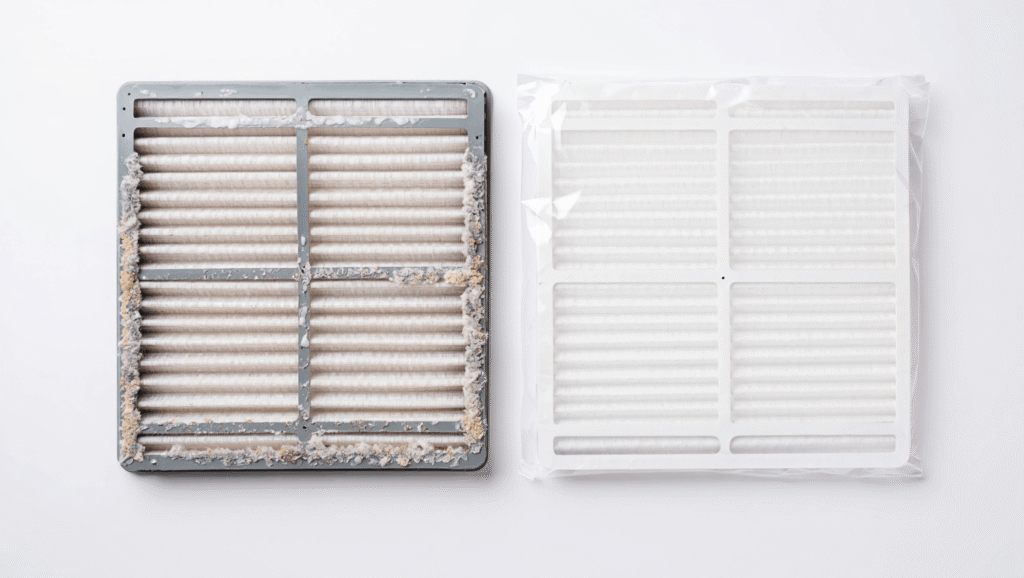
Pull out the filter and hold it up to the light. If you cannot see light through it, replace it immediately. A clogged filter is the single most common cause of poor cooling.
Here’s why a dirty filter does so much damage. A dirty air filter restricts airflow over the evaporator coil. Cold air builds up inside the unit, lowering the temperature to the point where ice begins to form on the coil. That ice then prevents the system from functioning properly. So what started as a $5 filter problem can turn into a frozen coil situation if left long enough.
Filters should be checked monthly during heavy-use seasons and replaced every 1 to 3 months depending on how dusty your home is and whether you have pets. If yours looks gray and packed, change it now before moving on to anything else.
Fix 3. Look for a Tripped Breaker
Your air conditioner runs on two separate circuits — one for the indoor air handler and one for the outdoor condenser unit. Either one can trip independently, which creates a confusing situation where the system seems to be partially running but isn’t actually cooling.
Check the electrical panel for a breaker labeled “AC,” “Condenser,” or “Air Handler.” Reset it once if it’s tripped. If it trips again immediately, stop and call a technician.
Also check whether the outdoor unit has a disconnect box nearby — a gray or black box mounted on the wall next to the condenser. Inside it is a pull-out block or fuse that sometimes comes loose or fails. Pull the block out, inspect the fuses for signs of burning or damage, and push it firmly back in.
Fix 4. Check All Your Vents and Registers
Walk through every room in your house and make sure every supply vent is fully open and unobstructed. It sounds too simple, but closed vents in unused rooms are a common cause of the whole system underperforming.
When vents are closed, the system builds up pressure inside the ductwork. That increased pressure causes air to escape through duct leaks instead of reaching your rooms, and it reduces airflow over the evaporator coil — which, as you saw in Fix 2, leads to freezing.
While you’re at it, check that no furniture, rugs, curtains, or boxes are covering any vents. A couch pushed against a vent can cut the effective airflow for that entire zone.
Fix 5. Clean the Outdoor Condenser Unit
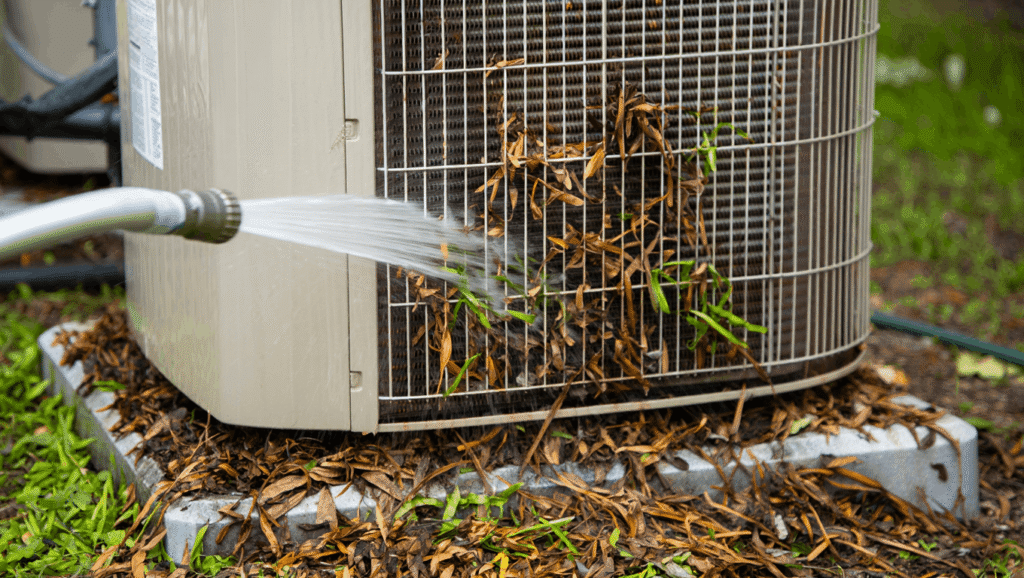
Go outside and take a look at your outdoor unit. If there are leaves, grass clippings, dirt, or other debris packed against the sides of the unit, that’s almost certainly reducing your cooling.
When the condenser is full of leaves and debris, it can’t properly remove heat from the refrigerant, which means it can’t cool your home effectively. Spray the unit down with a garden hose to remove the debris, and you may just notice a difference in your home’s temperature. Do not use high water pressure — a gentle spray is enough.
You should also check whether anything is growing around or near the unit. Weeds and grass growing up against the condenser block airflow and force the unit to work harder than it should. Trim anything within two feet of the unit on all sides.
After rinsing, let the unit dry for about 30 minutes before turning the system back on.
Fix 6. Check if the Evaporator Coil Is Frozen
If your AC is blowing air that’s barely cooler than room temperature, or if the airflow feels noticeably weaker than usual, you may have a frozen evaporator coil. This happens more often than people realize, and it’s usually a symptom of another problem rather than a failure on its own.
Signs of a frozen evaporator coil include poor indoor cooling, excessive water drainage near your indoor unit, and frost formation on the copper refrigerant tubing near the air handler.
If you see ice anywhere on the system, here’s what to do. Turn the AC off entirely but leave the fan running on the “Fan” setting. This helps thaw the ice without running the compressor. Give it 2 to 3 hours. Do not try to chip or scrape ice off the coil.
A frozen evaporator coil is most commonly caused by restricted airflow from a dirty air filter, blocked vents, or closed registers. So go back and make sure you’ve done Fix 2 and Fix 4 before running the system again. If the coil keeps freezing after you’ve addressed airflow, the cause is likely a refrigerant issue — which brings us to Fix 7.
Fix 7. Watch for Signs of Low Refrigerant
Refrigerant is the substance that makes cooling physically possible. If it leaks out, the system loses its ability to transfer heat — and no amount of running will make the house cooler.
This is not something you can fix yourself. Handling refrigerant requires EPA certification, and adding refrigerant without finding and fixing the leak first just delays the problem. But you can identify whether this is likely your issue before calling anyone.
Signs of a refrigerant problem include warm air coming from your vents even though the system is running, hissing or bubbling sounds near the indoor unit or outdoor condenser, and ice buildup on the evaporator coil.
If you notice an oily residue around your indoor coil or a hissing sound near the indoor or outdoor unit, call an HVAC professional right away. A refrigerant leak should be handled by a trained professional.
If this sounds like your situation, turn the system off to prevent compressor damage and schedule a service call. A technician will find the leak, repair it, and recharge the system.
Fix 8. Rinse and Inspect the Condensate Drain Line
Your AC pulls moisture out of the air as it cools — that’s the water that drips from the outdoor unit and from the drain pan inside. That water flows out through a condensate drain line, usually a white PVC pipe near the indoor unit.
When that line gets clogged with algae or debris, water backs up into the drain pan. Many systems have a float switch that shuts the AC off entirely when the pan fills, to prevent water damage. If your AC keeps turning itself off or if you see water pooling near the indoor unit, this is likely the cause.
The fix is usually simple. Find the access point on the drain line — often a T-shaped cap near where the line exits the unit. Pour about a cup of distilled white vinegar into it and let it sit for 30 minutes. This kills algae buildup and loosens any clog. Flush with water after. Doing this once a month through the summer prevents the problem from coming back.
Fix 9. Make Sure the Outdoor Unit Is Actually Running
Sometimes the indoor air handler runs fine but the outdoor condenser unit isn’t running at all. You’ll feel air coming from your vents, but it won’t be cold — because without the outdoor unit, there’s no heat exchange happening.
Go outside and listen. You should hear the fan on top of the outdoor unit spinning. If it’s silent while the indoor system is running, the outdoor unit has lost power or has a failed component.
Check the circuit breaker and the outdoor disconnect box first (Fix 3). If both look fine and the unit still isn’t turning on, the problem could be a failed capacitor — the component that starts the compressor and fan motor. A pitted or burned contactor is another common cause — this is a relay that switches power to the compressor when the thermostat calls for cooling. Burned contacts prevent the outdoor unit from starting even though the indoor air handler runs fine.
Both the capacitor and contactor are relatively inexpensive parts, but replacing them means working near high-voltage components inside the outdoor unit. This is a job that many confident DIYers tackle with the right precautions, but it’s also completely reasonable to hand this one to a technician.
Fix 10. Think About Whether the System Is the Right Size
If your AC seems to run constantly without ever fully cooling the house — and you’ve already checked everything above — the issue may not be a malfunction at all. It may be that the system is undersized for the space it’s trying to cool.
Sizing issues, such as having an AC unit that is too large or too small for your space, lead to inefficient cooling and frequent breakdowns. An undersized unit will run all day without reaching your set temperature, especially during heat waves. American Home Shield
An oversized unit has the opposite problem — it cools too fast, shuts off before removing enough humidity, and leaves the house feeling clammy and uncomfortable even at the right temperature.
If your home has had new additions, you’ve replaced single-pane windows, added insulation, or made other significant changes since the system was installed, it’s worth having an HVAC contractor do a load calculation to confirm your system is properly sized.
When to Stop Troubleshooting and Call a Technician
Most of the fixes above are genuinely within reach for any homeowner. But there are situations where continuing to troubleshoot yourself isn’t safe or effective.
Call a licensed HVAC technician if the breaker trips again right after reset. Call if you smell burning or notice the system making new noises. Call if you see visible ice on the refrigerant lines or coil that doesn’t clear after thawing. Call if refrigerant signs are present — hissing sounds, warm air only, or oily residue on the lines.
During peak summer, expect wait times of 2 to 3 days when you call for service. That’s all the more reason to work through this list first — you might save yourself both the wait and the bill.
FAQ
Why is my AC running but not cooling the house below 80 degrees?
This usually points to one of a few things: a dirty condenser unit that can’t dump heat efficiently, low refrigerant from a slow leak, a system that’s undersized for the square footage, or extremely high outdoor temperatures that are simply overwhelming the unit’s capacity. Start by cleaning the condenser and replacing the air filter. If those don’t help, the refrigerant level is worth having checked.
My AC was working fine yesterday. Why did it suddenly stop cooling?
Sudden loss of cooling with no gradual decline often points to a tripped breaker, a failed capacitor in the outdoor unit, or the outdoor unit shutting itself off due to overheating. Check the breaker and disconnect box first, then go outside and see whether the outdoor unit is running. If the outdoor unit is dead but the indoor air handler is running, the capacitor or contactor is a likely suspect.
Why does my AC cool well in the morning but not in the afternoon?
This is a sign the system is working but can’t keep up during peak heat. It usually means the condenser is dirty and struggling under heavy load, the system is slightly undersized, or the filter is partially clogged. Clean the outdoor unit and replace the filter. If the problem persists, have a technician check the refrigerant charge — low refrigerant systems often perform acceptably in mild heat but fall apart on the hottest days.
Is it bad to run the AC when it’s not cooling?
It depends on the cause. Running the system with a clogged filter or dirty condenser is fine temporarily but worsens over time. Running it with a refrigerant leak can damage the compressor, which is the most expensive component in the system. Running it with a frozen coil is counterproductive and can also damage the compressor. If the system isn’t cooling and you’re not sure why, it’s safer to turn it off until you’ve identified the cause.
How often should I clean the outdoor condenser unit?
At minimum, once a year before the cooling season starts. If you live in a dusty area, have nearby trees that drop seeds or debris, or run the system heavily, a mid-season rinse in July or August is worth doing. The cleaning itself takes about 10 minutes with a garden hose.
Can a dirty air filter cause my AC to stop blowing cold air entirely?
Yes. A severely clogged filter restricts airflow enough to cause the evaporator coil to freeze solid. Once the coil is frozen, no air can pass through at all — so the system blows little or no air and what does come out isn’t cold. Turn the system off, replace the filter, and let the coil thaw for 2 to 3 hours with just the fan running before restarting.
My AC is blowing cold air but the house won’t cool down. What’s going on?
If the air at the vent feels cold but the house temperature isn’t dropping, the air isn’t getting where it needs to go. Look for leaky or disconnected ductwork, closed vents in multiple rooms, or a duct layout that’s leaving certain areas of the house underserved. Also check whether any doors are blocking airflow between rooms — air needs a return path to the unit to circulate properly.
How do I know if my AC needs refrigerant?
You can’t check refrigerant level yourself without equipment, but the signs are recognizable: warm air from the vents despite the system running, ice forming on the copper lines near the outdoor unit, a hissing or bubbling sound, or a system that used to cool well but has gradually gotten less effective over months. If multiple of those apply, call an HVAC technician — only a licensed professional can legally handle refrigerant.