
If your circuit breaker keeps tripping — especially if it trips again right after you reset it — your electrical system is trying to tell you something. The good news is that most of the time, the cause is something you can figure out yourself in about ten minutes. Sometimes the fix is as simple as moving a few appliances around. Other times it points to a wiring problem that needs a licensed electrician.
Either way, the worst thing you can do is keep resetting the breaker and hoping it stops. This guide will help you understand exactly what’s happening, find the cause, and figure out your next step.
What a Circuit Breaker Actually Does
Before getting into why it keeps tripping, it’s worth understanding what the breaker is doing in the first place.
A circuit breaker is a safety device located inside your home’s electrical panel. It monitors the flow of electricity through individual circuits, each of which powers a specific section of your home — like a group of outlets in the kitchen or the lights in a bedroom. When something goes wrong, the breaker shuts off to protect the circuit from overheating, catching fire, or damaging equipment.
So when your breaker trips, it’s not malfunctioning — it’s doing exactly what it’s supposed to do. The problem is whatever is causing it to trip in the first place.
The Most Common Reasons a Circuit Breaker Keeps Tripping
You’re Overloading the Circuit
This is by far the most common cause, and it’s the one you can usually fix yourself without touching a single wire.
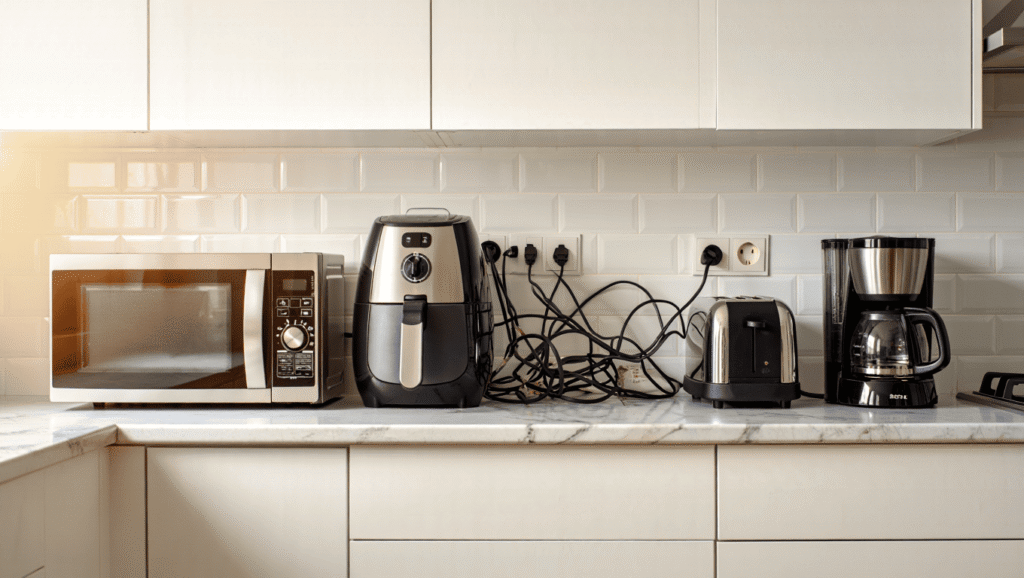
An overloaded circuit has too many things running on it at once. Kitchen small appliance circuits are rated at 20 amps. A 1,200-watt microwave draws 10 amps. A 1,700-watt air fryer draws about 14 amps. Running both appliances at the same time puts 24 amps on a circuit designed for 20 amps. Over time, those extra amps will damage the wires by generating excessive heat. A circuit breaker stops this overload condition by opening the circuit.
A good rule of thumb that most electricians follow: a circuit should not run above 80 percent of its rated amperage continuously. That means no more than 12 amps on a 15-amp circuit, and 16 amps on a 20-amp circuit. Anything above that, and you are likely to trip the breaker — especially with appliances that draw extra power when they first start up.
How to tell if this is your problem: The breaker trips only when you’re running multiple appliances at the same time. It holds fine when the circuit isn’t fully loaded.
The fix: If your breaker started tripping suddenly, note which devices were running when it happened. That’s often the quickest way to pinpoint the overload. Then spread high-draw appliances across different circuits. A microwave and a toaster should not be on the same circuit as your coffee maker.
There’s a Short Circuit
A short circuit is more serious than an overload, and it’s something you should not try to repair yourself unless you have electrical experience.
A short circuit happens when a hot wire comes in contact with another hot wire, or the neutral or ground. When a circuit operates normally, current flows on the hot wire from your electrical panel to a light, appliance, or other load. When those wires touch, electricity takes a shortcut and creates a massive surge. The breaker trips instantly to prevent a fire.
You may also hear a pop or see scorch marks near the outlet when this happens.
Signs you have a short circuit:
- The breaker trips instantly the moment you reset it, even with nothing plugged in
- You smell something burning near an outlet or appliance
- You see blackening or discoloration around an outlet cover
- You heard a popping sound right before the power went out
How to check: If your breaker trips immediately, even with nothing plugged in, it’s likely you have a short, not an overload. Unplug everything on that circuit first. If it still trips with nothing connected, the short is in the wiring itself — call an electrician.
If it holds with everything unplugged, plug devices back in one at a time. When it trips again after reconnecting a specific appliance, that appliance is causing the short.
A Ground Fault Is Happening
A ground fault is similar to a short circuit but with a slightly different cause. A ground fault occurs when a hot wire touches a grounded part of the system, like the metal housing of an appliance or the ground wire itself. Ground faults are especially dangerous in wet areas like kitchens, bathrooms, and outdoor spaces.
If your breaker keeps tripping in a bathroom, kitchen, laundry room, or garage — especially when water is involved — a ground fault is a likely culprit.
Many of these circuits are protected by ground fault circuit interrupters (GFCI) — outlets with “TEST” and “RESET” buttons that trip instantly to prevent shock. Before assuming the panel breaker is the issue, check whether any GFCI outlets on that circuit have tripped. They often have small buttons between the two plug slots. Press the RESET button on any that have tripped and see if that restores power.
If GFCI outlets keep tripping, there may be moisture getting into the wiring, a damaged cord, or a faulty appliance — all of which warrant a closer look by a professional.
A Faulty Appliance Is Causing the Trip
Sometimes the problem has nothing to do with your wiring or panel. Older appliances with worn internal wiring or damaged cords can cause irregular current flow, which may trip the breaker. Even a newer appliance can trip the breaker if it draws too much current on startup or has an internal fault.
This is actually one of the easier problems to diagnose. Plug the suspected appliance into an outlet on a completely different circuit. If it trips that circuit too, the appliance itself is the problem. If it works fine on the other circuit, the original circuit may be overloaded or have a wiring issue.
Common offenders include space heaters, older refrigerators, washing machines, hair dryers, and any appliance that has taken physical damage to its cord.
The Breaker Itself Has Worn Out
Breakers don’t last forever. If your circuit breaker keeps tripping immediately, no matter what, then you may have a bad circuit breaker. Circuit breakers need regular maintenance and can sometimes fall into disrepair.
This is more common in older homes where the panel hasn’t been touched in 20 or 30 years. A breaker that trips under normal loads that it used to handle without issue — and where you’ve ruled out overloading, shorts, and ground faults — is likely just worn out and needs to be replaced.
Replacing a single breaker is a job for a licensed electrician. It requires working inside the panel with live wires present.
Arc Faults in the Wiring
AFCI (Arc Fault Circuit Interrupter) breakers trip whenever they detect an electrical arc, or spark, within a wire. Arcs tend to occur in the early stages of an electrical problem, so AFCI breakers shut the circuits down before the degradation develops into something more dangerous.
If your home was built after 1999 or recently had electrical work done, you may have AFCI breakers in your panel. They look slightly different from standard breakers and often have a small test button on the face of the switch. If one of these keeps tripping, it’s detecting arcing somewhere in the circuit — damaged wiring, a loose connection, or a failing device. This needs an electrician.
How to Reset a Circuit Breaker (The Right Way)
Most people just flip the switch back to the ON position and call it done. That’s not quite right, and it can actually cause the breaker to not reset fully.
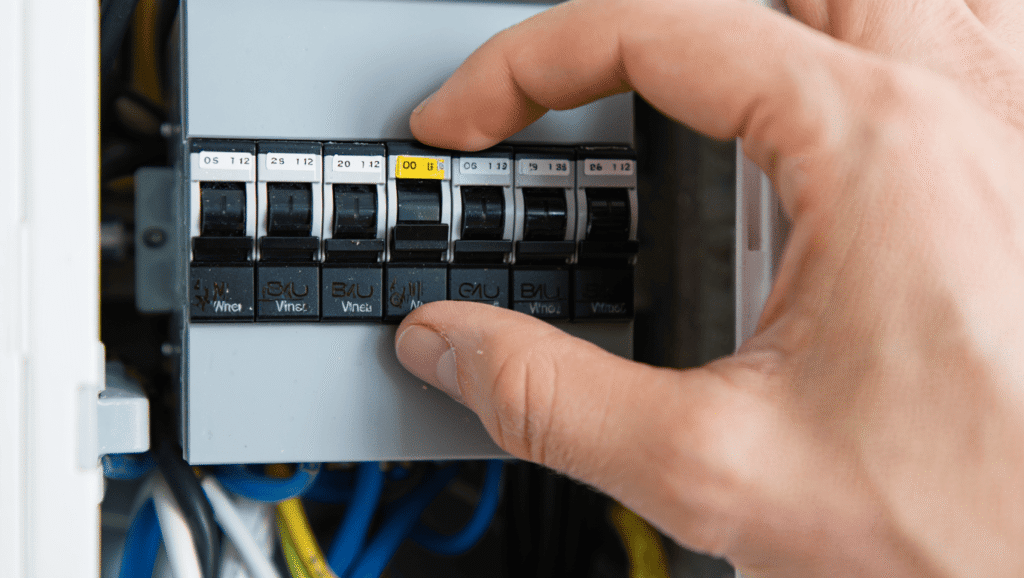
Here’s how to do it correctly:
First, go to your electrical panel — usually in a basement, utility room, hallway, or garage. Open the front cover.
Look for the breaker with the handle in a different position than the others. On a tripped breaker, the handle will be in the middle, neither On nor Off. Some panels have a red or orange indicator window that appears when a breaker trips.
Before you reset anything, unplug or turn off appliances in the area that lost power. This reduces the load when the circuit comes back on.
To reset, flip the handle to the OFF position first, then flip it to ON. Stand to the side of the panel and turn your face away when flipping breakers. If an arc flash occurs, it may save your life.
If the breaker holds, go back and turn devices on one at a time. Watch for it to trip again as you add load.
If it trips immediately after reset — even before you touch anything else — stop. Do not keep resetting it. There’s a short circuit or wiring fault that needs professional attention.
Never reset the breaker if:
- You smell burning or see smoke anywhere
- The panel or outlets feel warm or hot to the touch
- You see scorch marks around any outlet
- There is water near the panel or the affected outlets
What You Can Fix Yourself vs. What Needs an Electrician
Being honest about this matters, because working inside an electrical panel is genuinely dangerous.
You can handle these yourself:
Spreading appliances across different circuits to fix an overload. Pressing the RESET button on a tripped GFCI outlet. Unplugging and testing appliances one by one to find a faulty device. Basic breaker resets following the steps above.
Call a licensed electrician for these:
The shutoff valve behind the toilet doesn’t close fully — old shutoff valves can seize, corrode, or fail to close fully. Forcing them can cause them to break entirely. (This applies equally to your electrical panel — if the breaker keeps tripping after reset, don’t force it repeatedly.) Any suspected short circuit or ground fault in the wiring. A breaker that feels warm, smells burnt, or shows visible damage. Replacing a worn-out breaker. Adding circuits to the panel. Upgrading an outdated panel that can’t handle your home’s current power needs.
A repeatedly tripping breaker left unchecked can cause fire hazards, equipment damage from irregular power supply, and potential electrocution risks — especially with ground faults where current might flow through someone standing on a wet surface.
How to Stop Your Breaker From Tripping in the Future
Most repeat tripping comes down to a few habits worth changing.
Know which appliances are on which circuit. High-draw appliances — space heaters, window AC units, hair dryers, microwaves — should each have their own circuit or at least be on separate circuits. Running two of them together is often enough to push a 15-amp or 20-amp circuit past its limit.
Check your cords regularly. Damaged or frayed cords are a major source of shorts and ground faults. If a cord looks worn, cracked, or has been pinched under furniture, replace the appliance before plugging it back in.
Avoid using harsh chemical cleaners that can affect your home’s rubber components — and the same logic applies to your electrical environment. Keep moisture away from outlets, especially in bathrooms, kitchens, and garages.
If your home is more than 25 years old and still has the original panel, have an electrician assess whether it has enough capacity for how you actually use electricity today. Most older panels were designed for a fraction of what a modern home runs — no EV charger, no home office, no smart appliances.
FAQ
Why does my circuit breaker keep tripping with nothing plugged in?
If the breaker trips with nothing connected to any outlet on that circuit, the problem is almost certainly in the wiring itself — a short circuit, damaged insulation, or a loose wire inside a junction box or outlet. This is not a DIY repair. Turn that breaker off and leave it off until an electrician can look at it.
Is it dangerous to keep resetting a tripping breaker?
Yes, if there’s an underlying fault causing it to trip. Resetting a breaker over and over without fixing the root cause means the wiring is repeatedly overheating or experiencing surges. Over time that can damage insulation, melt wires, and start a fire inside your walls. One reset to diagnose the problem is fine. Repeated resets without a fix are not.
Can a tripping breaker damage my appliances?
It can, particularly sensitive electronics. Sudden power cuts and restoration cause voltage spikes that can affect computers, TVs, and anything with a circuit board. If the same circuit trips repeatedly, unplug sensitive devices until you’ve found and fixed the cause.
What’s the difference between a tripped breaker and a blown fuse?
A breaker trips and can be reset. A fuse blows and has to be physically replaced. Older homes built before the 1960s often have fuse boxes rather than breaker panels. If you have a fuse box and a fuse keeps blowing, the diagnostic process is similar — but the solution is always replacing the fuse with one of the correct amperage rating, never with a higher-rated fuse.
How do I know which breaker controls which room?
Most panels have labels next to each breaker, though in older homes those labels are often wrong or missing. The best way to map your panel is to plug a lamp into various outlets and have someone watch while you flip breakers one at a time. Write down what each controls. This takes 20 minutes and will save you a lot of guesswork the next time something trips.
Can I replace a circuit breaker myself?
Technically yes, but it’s not recommended for most homeowners. Working inside the panel means working near bus bars that remain live even when the main breaker is off. The risk of a serious shock or arc flash is real. It’s one of those jobs that’s genuinely worth paying a licensed electrician to handle.
My breaker trips only at night. What could cause that?
Usually this points to a specific appliance that runs on a timer or cycle — an HVAC system, a water heater, a refrigerator compressor kicking on, or something on a timer. It can also happen in hot weather when the home’s total electrical load peaks in the evening and pushes an already-loaded circuit over the edge. Start by noting exactly what time it trips and which appliances are actively running at that moment.
How long do circuit breakers last?
Most breakers are designed to last 30 to 40 years, but they can wear out faster with repeated trips. A breaker that has tripped hundreds of times over its life may become more sensitive or less reliable. If your panel is 25 or more years old and breakers are tripping under normal loads that wouldn’t have been an issue before, the breakers may simply be wearing out.