
You go to plug something in and nothing happens. The outlet is completely dead — no power, no indication anything is wrong, no tripped breaker that you can see. This is one of the more common calls electricians get, and the good news is that about 70 percent of the time, the fix takes less than five minutes and requires zero tools. The other 30 percent splits between problems you can safely investigate yourself and a smaller number that genuinely need a professional.
This guide walks through the six things to check in order, starting with the ones that solve most cases immediately and working toward the ones that require more investigation. Work through them in sequence before you call anyone.
Before Anything Else — Test the Device, Not the Outlet
This sounds obvious, but it gets missed more often than you would expect. Before concluding the outlet is dead, plug something that you know for certain is working into it — a phone charger you just used, a lamp that was on five minutes ago, anything with a clear and definite output. If the known-working device also fails, the outlet is the problem. If it works fine, the original device you were trying to use is the issue, not your wiring.
Also check the device’s own fuse or reset button if it has one. Power strips, surge protectors, and certain appliances have a small reset button or inline fuse that trips independently of anything in your walls. A tripped reset button on a power strip can look exactly like a dead outlet if you are not expecting it.
Check 1. Find and Reset a Tripped GFCI Outlet
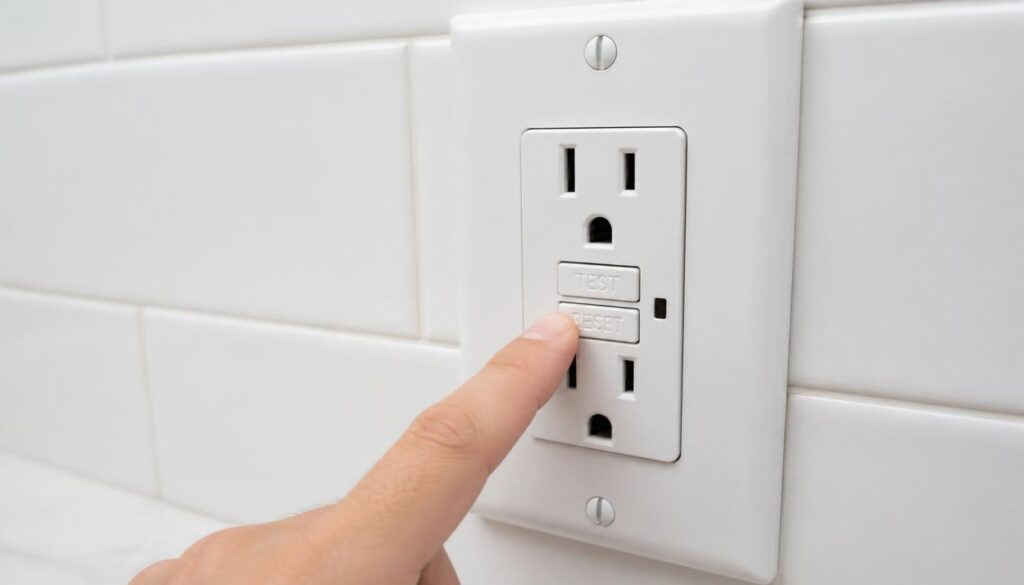
This is the cause behind roughly 7 out of 10 dead outlet calls, and the fix takes about 10 seconds once you find the right outlet. A GFCI (ground fault circuit interrupter) is a safety device built into certain outlets that monitors electrical flow and cuts power instantly if it detects a dangerous imbalance. You recognize them by the two small rectangular buttons — labeled TEST and RESET — in the center of the outlet face.
Here is the part that throws most people off: one GFCI outlet can control power to several completely separate outlets on the same circuit, including outlets in other rooms. So if the outlet you are trying to use is dead and has no TEST or RESET buttons, there is still almost certainly a GFCI somewhere that controls it — you just need to find it.
Check these locations first: any outlet in the bathroom, any outlet in the kitchen, the garage, the basement, any outdoor outlets, and any outlets in a utility room or laundry area. Press the RESET button firmly on every GFCI outlet you find, even if it does not appear to be tripped. Some GFCI outlets do not show a visible indication that they have tripped — the button just looks like it always does, but pressing it restores power. After pressing each RESET button, go back to the dead outlet and test it.
If the GFCI trips again immediately after you reset it — meaning it will not stay in the reset position — do not keep pressing it. A GFCI that will not hold its reset has detected a real problem and is doing exactly what it is supposed to do. At that point, unplug everything connected to that circuit and call an electrician.
Check 2. Look at the Breaker Panel — Including Breakers That Appear On
If resetting the GFCI did not restore power, go to your electrical panel. Look for any breaker whose handle is not aligned with the others — a tripped breaker sits in a middle position between ON and OFF, or it may have an orange or red indicator window on the face of the switch. Flip any tripped breaker all the way to OFF first, then back to ON. Do not just push it back to ON from the middle position — that often does not fully reset the internal mechanism.
Here is something most homeowners do not know: a breaker can appear to be in the ON position and still not be supplying power. This happens when a breaker has partially tripped — the handle stays near the ON position but the internal contacts have opened. The only reliable way to rule this out is to flip every breaker that could plausibly control the affected area fully off and then back on, even the ones that look fine.
If a breaker trips again immediately after you reset it, stop. A breaker that will not stay reset means the circuit has a fault — a short, an overload, or a wiring problem — that is causing the trip. Resetting it repeatedly can cause heat buildup and, in some cases, fire. Turn the breaker off and leave it off. For a deeper look at why breakers keep tripping and what each cause means, the full breakdown is covered in our guide on circuit breaker keeps tripping.
Also check whether your home has a sub-panel — a second, smaller electrical panel often found in a garage, workshop, basement, or finished addition. Sub-panels have their own breakers that are completely separate from the main panel.
Check 3. Is There a Wall Switch That Controls the Outlet?
In many American homes, particularly in living rooms and bedrooms, one or both of the outlets on a duplex receptacle are controlled by a wall switch rather than being always-on. This is called a half-hot or switched outlet, and it is one of the most common non-problems that gets misdiagnosed as a dead outlet or a wiring fault.
The reason it causes confusion is that the outlet looks completely normal. Nothing about the outlet face tells you it is switch-controlled. Electricians wire it this way so homeowners can control floor lamps without reaching behind furniture — but if you did not put the lamp there yourself, you may have no idea a switch is involved.
Try every wall switch in the room, including any you have never used. Flip each one and test the outlet after each flip. If you find a switch that seems to do nothing visible — no light comes on — it may be controlling the outlet you are testing. This solves the “dead outlet” situation in a surprising number of cases, especially in older homes and newer construction where switched outlets are common.
Check 4. Test Other Outlets Nearby and Map the Pattern
Plug a working lamp or phone charger into every other outlet in the room, then outlets in adjacent rooms. Pay attention to the pattern of what is dead and what is not — that pattern tells you whether you are looking at a localized outlet problem or a circuit-level issue.
If only one outlet is dead and everything else in the room works, the problem is almost certainly in that specific outlet box — a loose wire, worn contacts, or a failed receptacle. That keeps the diagnosis contained and manageable.
If multiple outlets in the same room or area are dead, you likely have a circuit issue — either a breaker that is not supplying power despite looking on, or a GFCI you have not found yet. Go back through Check 1 and Check 2 more thoroughly before moving further.
If outlets on both sides of a wall are dead, or a whole section of the house has gone dark, that points to a larger circuit problem or possibly a failing breaker that needs replacement. This is beyond DIY territory — a breaker that has lost partial function but has not fully tripped needs to be replaced by a licensed electrician working in a live panel.

Check 5. Look at the Outlet Itself for Signs of Failure
If you have confirmed the breaker is on, there is no controlling GFCI, and no wall switch is involved — but the outlet is still dead — the outlet itself may have simply failed. Outlets wear out. The internal spring contacts that grip a plug’s prongs lose tension over thousands of insertion cycles, and the electrical connections inside the box can corrode or loosen over years of thermal expansion and contraction.
Before removing anything, look at the outlet face carefully. Any of the following is a sign the outlet has failed and should not be used under any circumstances until it is replaced.
Scorch marks or discoloration around the slots. Black or brown marks on the outlet face indicate arcing inside the box — electricity jumping across a gap rather than flowing through its intended path. This is a fire hazard.
The wall plate or outlet feels warm. A properly functioning outlet should never be warm to the touch during normal use. Warmth indicates resistance in the connection — heat being generated by a loose or corroded wire — which can ignite surrounding materials over time.
A burning smell near the outlet. Electrical burning has a very distinctive smell — slightly chemical, like hot plastic or hot metal. If you smell it anywhere near an outlet, turn off the breaker for that circuit immediately and do not restore power until an electrician has inspected the wiring.
The outlet is physically cracked or broken. A cracked outlet face exposes internal contacts and creates a shock and arcing risk. Replace it regardless of whether it currently works.
Plugs do not stay seated or fall out easily. This means the contact springs have worn out and the outlet is no longer making reliable contact. An outlet in this condition can arc intermittently even when a plug appears to be connected.
If you see any of these signs, turn the breaker off for that circuit and do not use the outlet. Replacing a standard outlet is a straightforward job — similar in difficulty to replacing a light switch — but if there are scorch marks or signs of arcing inside the box, have an electrician assess the wiring before installing a new receptacle. Burned wiring inside the box is not solved by swapping the outlet.
Check 6. Loose Wiring — The Cause You Cannot See Without Opening the Box
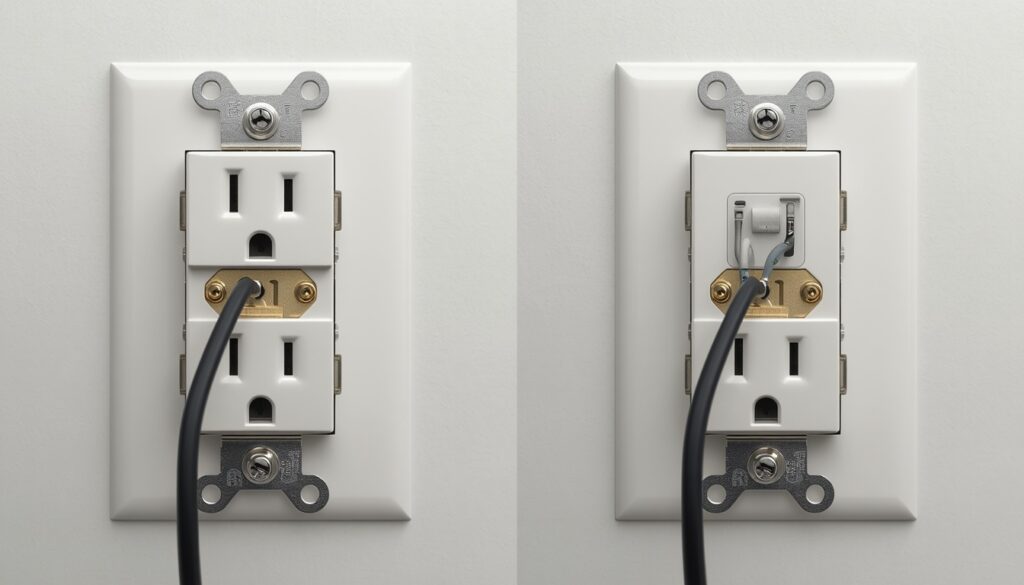
The leading cause of a dead outlet with a live breaker and no tripped GFCI is loose wiring. Outlets come with two options for wire attachment: rear push-in slots (called backstab connections) or side terminal screws. Backstab connections are faster to install, which is why they were used on a huge percentage of outlets installed from the 1970s through the 1990s. They are also significantly less reliable over time.
A wire pushed into a backstab connector is held only by a small spring clip. Over years of thermal expansion and contraction as the outlet heats and cools with use, these clips can loosen. Once a wire loses contact with the connector, power stops flowing through the outlet — sometimes intermittently, sometimes permanently. The outlet looks completely normal from the outside. Nothing indicates anything is wrong until you test it and find it dead.
If your home is more than 20 years old and you have ruled out everything else in this list, a loose backstab connection is the most likely remaining explanation for a single dead outlet.
Opening an outlet box and checking connections is something a careful homeowner can do — but it requires turning off the correct breaker first and confirming with a non-contact voltage tester that the power is genuinely off before touching any wire. Pull the outlet out from the box after removing the cover plate and the two mounting screws. Tug gently on each wire where it enters the outlet body. Any wire that pulls free easily has lost its connection. Reconnect the wires to the side screw terminals rather than the backstab holes, which are the more reliable connection method, and reinstall the outlet.
If you are not comfortable opening the box or working near wiring — even with the breaker off — this is a completely reasonable job to hand to an electrician. A single outlet diagnosis and repair typically takes under an hour and costs $100 to $200 for a professional visit. That is a reasonable price for something you are not sure about.
Stop Immediately and Call an Electrician If You Notice Any of These
Most dead outlets are completely safe to investigate using the steps above. But some situations cross a line where continuing to troubleshoot yourself creates real danger. Stop what you are doing and call a licensed electrician if you encounter any of the following.
You hear buzzing, crackling, or popping near the outlet or from inside the wall. These sounds indicate arcing — electricity jumping across a gap in the wiring. Arcing inside a wall cavity is a leading cause of house fires and can start burning materials you cannot see from the outside.
The wall plate, outlet, or nearby wall surface is warm to the touch. Heat in a circuit means resistance, which means something is not connected properly and current is generating heat trying to get through. This does not get better on its own.
You smell burning anywhere near the area. The electrical burning smell — like hot plastic or a faint chemical odor — means something is already hot enough to be melting. Turn off the breaker for that circuit immediately.
The GFCI or breaker trips again immediately after you reset it. One reset is reasonable for diagnosis. Repeated resets on a device that will not hold are the same as ignoring what the safety system is telling you.
You see scorch marks, melting, or damage inside the outlet box. This is evidence of a past or ongoing arc event. The outlet is not the only thing that needs replacing — the wiring and box need to be inspected before power is restored.
Multiple outlets on different circuits have gone dead at the same time. When unrelated circuits lose power simultaneously, the problem is likely at the main panel — a failing main breaker, a loose neutral at the service entrance, or a utility supply issue. These require a licensed electrician or your utility company, not a homeowner investigation.
For a thorough overview of how residential electrical systems are structured and why wiring problems develop the way they do, the Wikipedia article on how residential electrical wiring works is a useful reference. The CPSC electrical safety guidance covers the most common household electrical hazards and what warning signs to take seriously.
Should You Replace the Outlet or Just Reset Something?
Most dead outlets do not need to be replaced. A GFCI reset, a breaker flip, or finding the controlling wall switch solves the majority of cases. But replacing the outlet itself makes sense in several situations.
Replace the outlet if it is more than 15 to 20 years old and has backstab connections — upgrading to screw-terminal connections takes 20 minutes and eliminates the most common cause of future failures on that outlet. Replace it if plugs no longer fit snugly, if the outlet is visibly damaged, or if it has ever shown scorch marks or unusual heat even if it currently appears to work. Replace it if it is in a bathroom, kitchen, garage, outdoor area, or any other location near water and does not currently have GFCI protection — this is a code requirement and a genuine safety issue regardless of whether the outlet is currently working.
Standard duplex outlets cost $2 to $8. GFCI outlets cost $15 to $30. The replacement itself is similar in difficulty and process to other basic electrical work — if you are comfortable with the steps involved, it is a reasonable DIY job with the breaker off and a voltage tester confirming the power is out. If you are not, an electrician can swap an outlet in under 30 minutes.
FAQ
Why is my outlet not working but the breaker is not tripped?
The most common reason is a tripped GFCI outlet somewhere else in the house that controls power to the dead outlet. GFCI outlets protect multiple outlets on the same circuit, including ones in different rooms, and they do not always show an obvious indication that they have tripped. Check every GFCI outlet in your bathrooms, kitchen, garage, and basement before concluding the problem is anything else. If all GFCIs check out and the breaker looks fine, the next most likely cause is a loose backstab connection inside the outlet box itself.
My outlet worked yesterday and stopped working overnight. What happened?
Sudden failure with no apparent cause usually points to one of three things. A GFCI tripped during the night — possibly from a brief current spike — and cut power. A backstab wire connection finally let go after gradually loosening over time. Or the outlet’s internal contacts have worn out and lost their ability to make reliable contact. Work through the GFCI check first, since that is by far the most common cause of sudden dead outlets. If that does not restore power, the problem is inside the outlet box.
Half of my outlet works and the other half does not. Is that normal?
It can be. A duplex outlet — the standard two-socket receptacle — can be wired so one socket is always on and the other is controlled by a wall switch. This is intentional wiring for switched outlets and is completely normal in living rooms and bedrooms. Try the wall switches in the room. If no switch restores the dead socket, the outlet has a split wiring fault and needs to be replaced or inspected by an electrician.
Can a dead outlet be dangerous even if it is not sparking?
Yes. A dead outlet with a loose wire inside the box can generate heat even without visible sparks, because the resistance at the loose connection point causes current to work harder to get through. That heat builds up in the outlet box and in the surrounding wall materials. You will not always hear or see anything from the outside. Warmth on the wall plate or a faint burning smell near the outlet are the warning signs — both mean turn off the breaker and get it inspected before using the outlet again.
How do I find which GFCI controls a specific outlet?
There is no shortcut other than checking all of them. GFCI outlets can control other outlets on the same circuit that are in completely unrelated locations — a GFCI in a first-floor bathroom can control an outlet in an upstairs bedroom if they share a circuit. Press the RESET button on every GFCI outlet in the house — bathrooms, kitchen, garage, basement, outdoors, and utility areas — then test the dead outlet after each reset. The one that restores power is the controlling GFCI.
The GFCI outlet keeps tripping every time I reset it. What does that mean?
A GFCI that will not hold its reset has detected a genuine ground fault — current flowing somewhere it should not be, which can be caused by a damaged appliance, moisture inside an outlet or junction box, or a wiring fault downstream. Unplug every device on that circuit and try the reset again. If it holds with everything unplugged, plug devices back in one at a time to find the one causing the fault. If it trips immediately even with nothing plugged in, the problem is in the wiring itself and needs an electrician.
Is it safe to use an extension cord on a dead outlet’s neighboring socket while I wait for a repair?
Only if the neighboring socket is on a different circuit or if you have confirmed the dead socket is an isolated failure with no signs of heat, burning smell, or scorch marks. If any of those warning signs are present, do not use any outlet in that area until the circuit has been inspected. Extension cords add load to a circuit and can accelerate a developing problem into an active one.
How long does it typically take an electrician to fix a dead outlet?
For a simple outlet replacement or loose wire reconnection, most electricians complete the job in 30 minutes to an hour. Diagnosis of a more complex wiring fault — tracing a problem through a circuit that has multiple outlets and junction boxes — can take two to three hours. The service call fee varies widely by region but typically runs $75 to $150, plus parts and labor. For a single outlet that you have already diagnosed as a backstab connection failure, having the electrician upgrade all the other outlets in the room while they are there is usually worth the incremental cost.